Skip to main content
Theoretical Models of Musical Development
David Hargreaves and Alexandra Lamont (2017)
from ‘Musical Development: Theoretical Models, Approaches, and Issues‘
Chapter 2 of The Psychology of Musical Development
Outline of this section:
- Developmental Stage / Phase Models
- ‘Spiral’ Model (Swanwick & Tillman)
- ‘Phase’ Model (Hargreaves & Galton)
- Music Learning and Cognition
- ‘Music as Cognition’ (Serafine)
- Music Learning Theory (Gordon)
- Symbol Systems
- Gardner & Harvard Project Zero
- Music Theory
- ‘Sounds of Intent’ Model (Ockelford)
- Social Approaches to Musical Development and Some Emerging Models
- Sociocultural Approaches
- Ecological & Transanctional Approaches
- Social Cognitive Approaches
- Neuroscientific Studies of Music
For each theoretical approach, Hargreaves & Lamont outline the general psychological theory before illustrating how it is applied to understanding the psychology of musical development by the relevant distinct approaches.
As we consider each approach and each theory, the authors ask us to consider 3 questions:
- How does this approach deal with musical production, perception, performance, and representation?
- How does this approach deal specifically with developmental progression?
- How does this approach deal specifically with music?
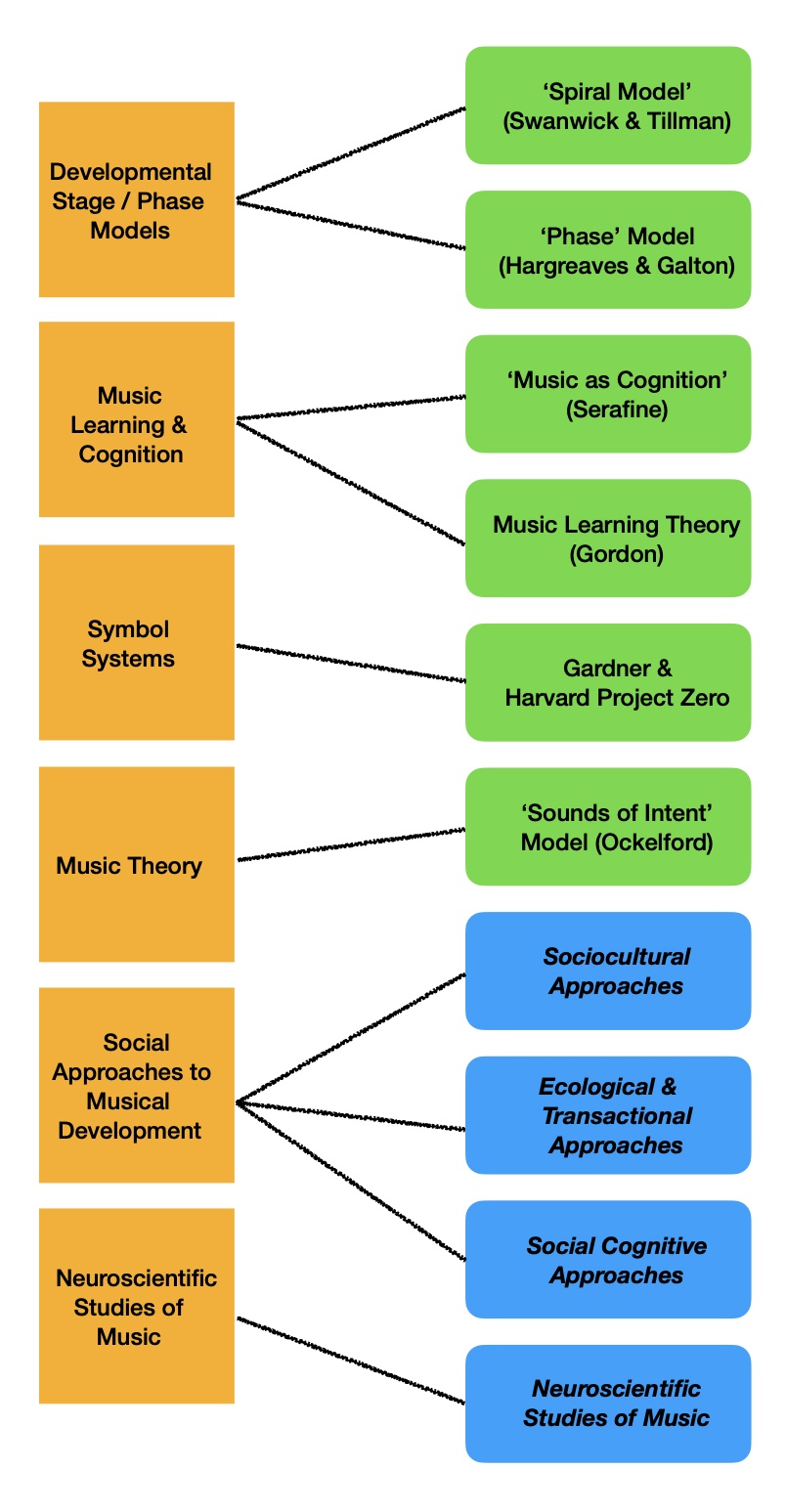
I’ve made a diagram to try to make clear the framework for this section of the chapter:
squares in yellow are the 6 general theoretical approaches
rectangles are the 10 distinct approaches
rectangles in green are the six approaches which have given rise to specific models of musical development
(the other 4 are the rectangles in blue, and with text in italics)